
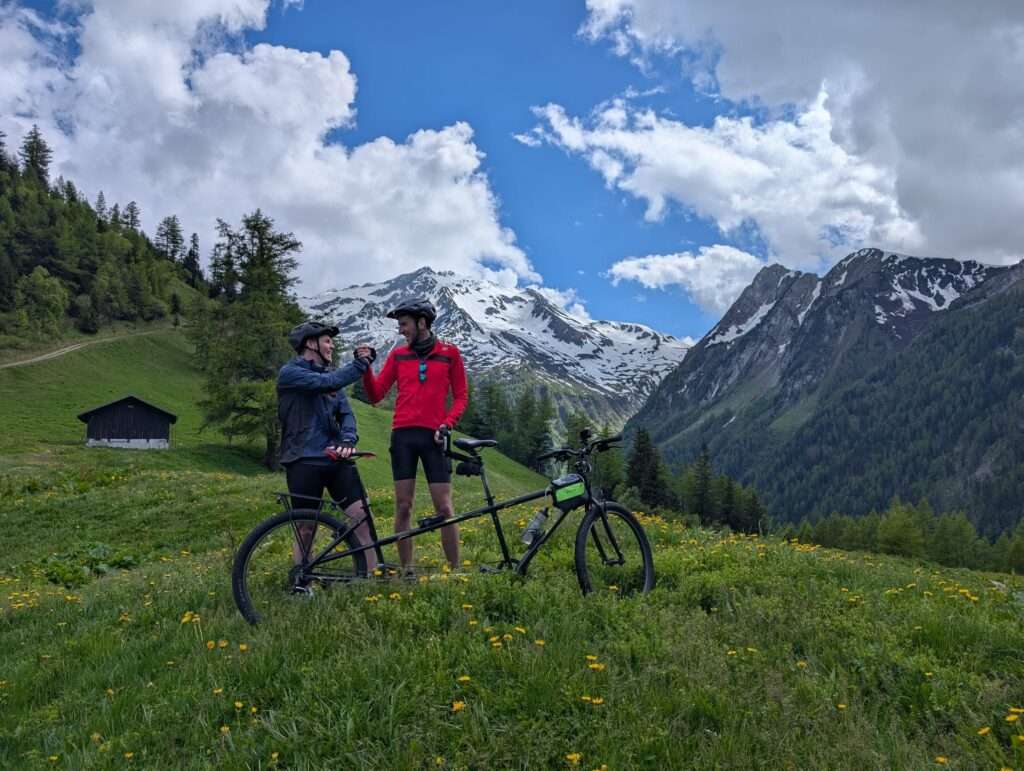
Between ice and water, between doubt and hope, we followed the trail of the Rhône by bike-tandem, from the glacier to Lake Annecy. An initiatory adventure, at the rhythm of melting and breath.
It all started up there, in the heart of the Swiss Alps, at more than 2,200 meters above sea level.
In front of us, the Rhône glacier. Or rather, what's left of it.
Under the white tarpaulin that is supposed to protect it from the sun, we distinguish a crevassed grey tongue marked by time. At our feet, the source of a mythical river, the one that irrigates our valleys, our cities, our lives.
A pure water, still cold, which will tomorrow become the Rhône, then the Mediterranean.
« In following this water, we wanted to understand what it tells us: about our excesses, our oblivions, but also about our ability to adapt. »
By our side, Ugo Nanni, a passionate glaciologist, shares the secrets of this sleeping giant.« Each year, the ice moves a little further, and with it, it is part of our alpine memory that disappears. Observing the Rhône glacier means seeing the climate change in front of our eyes, but it also means understanding how much water we take for granted depends on this fragile balance.
The descent begins. On our tandem bike, the first meters are hesitant. Two bodies, two rhythms, one direction.
The road winds between the mountains and in the rain.
Each turn reveals a waterfall, a torrent, a dam.
We cross the villages of Valais, where the inhabitants have always lived at the rate of water.
But as we descend, another face appears: that of canalized water, domesticated, sometimes forgotten.
Concrete canals replace streams, rivers dry up, meadows yellow.
« What if the water, which we thought was eternal, becomes a luxury tomorrow? »
Below, the mountain gives way to industrial areas.
The pipes succeed the torrents, the fumes replace the mist.
In this valley, water is no longer just a source of life — It also becomes a vector of pollution.
Chemical discharges, microplastics and wastewater are accumulating in the nascent Rhone, already marking the passage of human activity.
We realize that the river we follow, so pure at the source, bears from its first kilometers the trace of our model of development.
Each drop tells a story of abundance and forgetfulness.
The slope is straightening.
The tandem seems to weigh a ton.
Each pedal blow becomes an act of will, a struggle against gravity and the whistle.
In front of us, the laces chain.
Ascent to the Emosson Dam is not just a physical challenge — It is a rise to the source of what connects us all: water, this invisible energy that makes the heart of our mountains beat.
Around us, torrents deplete the rock, feeding the hydroelectric plants of Valais.
These infrastructures, discreet and powerful, provide an essential part of the electricity of Switzerland and, more broadly, of the European network.
« In France, about 20% of hydropower production is directly dependent on the Rhône, and almost 30% is indirectly linked to it. »
Every summer, their cast iron feeds the dams, guaranteeing the electricity production and irrigation of the valleys.
And every winter, their retreat promises a drier, more fragile, more dependent future.
« When the ice disappears, it's all an energy balance that is wavering. »
Au sommet, face au barrage, le silence s’impose.
L’eau retenue ici n’est pas qu’un réservoir — c’est un symbole de souveraineté, une ressource stratégique autant qu’un bien commun.
Elle éclaire nos foyers, fait tourner nos usines, irrigue nos cultures.
Mais derrière sa surface lisse se cache une vérité dérangeante :
moins de glace, c’est moins d’eau à stocker, moins d’énergie à produire, et plus de tensions à venir.
Nous prenons alors conscience que l’eau n’est pas seulement un élément du paysage — elle est la colonne vertébrale de nos sociétés.
Et qu’en la laissant s’épuiser, c’est notre autonomie que nous fragilisons.
“Préserver nos glaciers, c’est préserver notre lumière.”
En arrivant à Chamonix, impossible de ne pas lever les yeux vers les glaciers des Bossons et de Taconnaz.
Autrefois majestueux, ils reculent année après année, libérant des torrents et des blocs de glace qui inquiètent les habitants.
C’est en descendant du barrage d’Emosson que la nouvelle tombe :
Un glacier vient de s’effondrer en Suisse, non loin où nous avons pédalé hier. Les images nous figent. Ce n’est pas seulement de la glace qui s’écroule, mais une mémoire millénaire.
Ugo nous rassure pour expliquer les dispositifs de surveillance mis en place : radars, capteurs, sirènes d’alerte…
Le danger est réel, mais la science nous protège.
Et surtout, elle fédère : chercheurs, collectivités, citoyens travaillent ensemble pour s’adapter.
« Face à la fonte, l’important n’est pas seulement de mesurer, mais de réapprendre à écouter. »
Après seulement 48 heures, les jambes lourdes mais le cœur léger, nous atteignons Annecy, notre point d’arrivée.
Le lac, miroir des montagnes, nous accueille dans un calme presque irréel.
De la glace à la goutte, du sommet à la source, nous venions de boucler une boucle symbolique : celle de la vie.
Cette aventure n’était pas seulement un défi physique. C’était un voyage intérieur. Une manière de retisser le lien entre eau, santé et humanité.
L’eau façonne nos paysages, mais aussi nos émotions. Elle circule en nous comme elle traverse la Terre. Et si elle se dérègle, c’est notre équilibre à tous qui vacille.
Ce voyage, c’est le point de départ d’une nouvelle mission :
raconter, sensibiliser, transmettre.
À travers nos conférences, nos ateliers pédagogiques et notre futur documentaire, nous voulons redonner à chacun le goût de comprendre et d’agir.
Parce que préserver l’eau, ce n’est pas un combat d’écologistes. C’est une question de santé, de solidarité, d’avenir.
“Sur la route des glaciers”, c’est bien plus qu’une aventure.
C’est un appel à redescendre sur Terre, à retrouver la source du vivant.